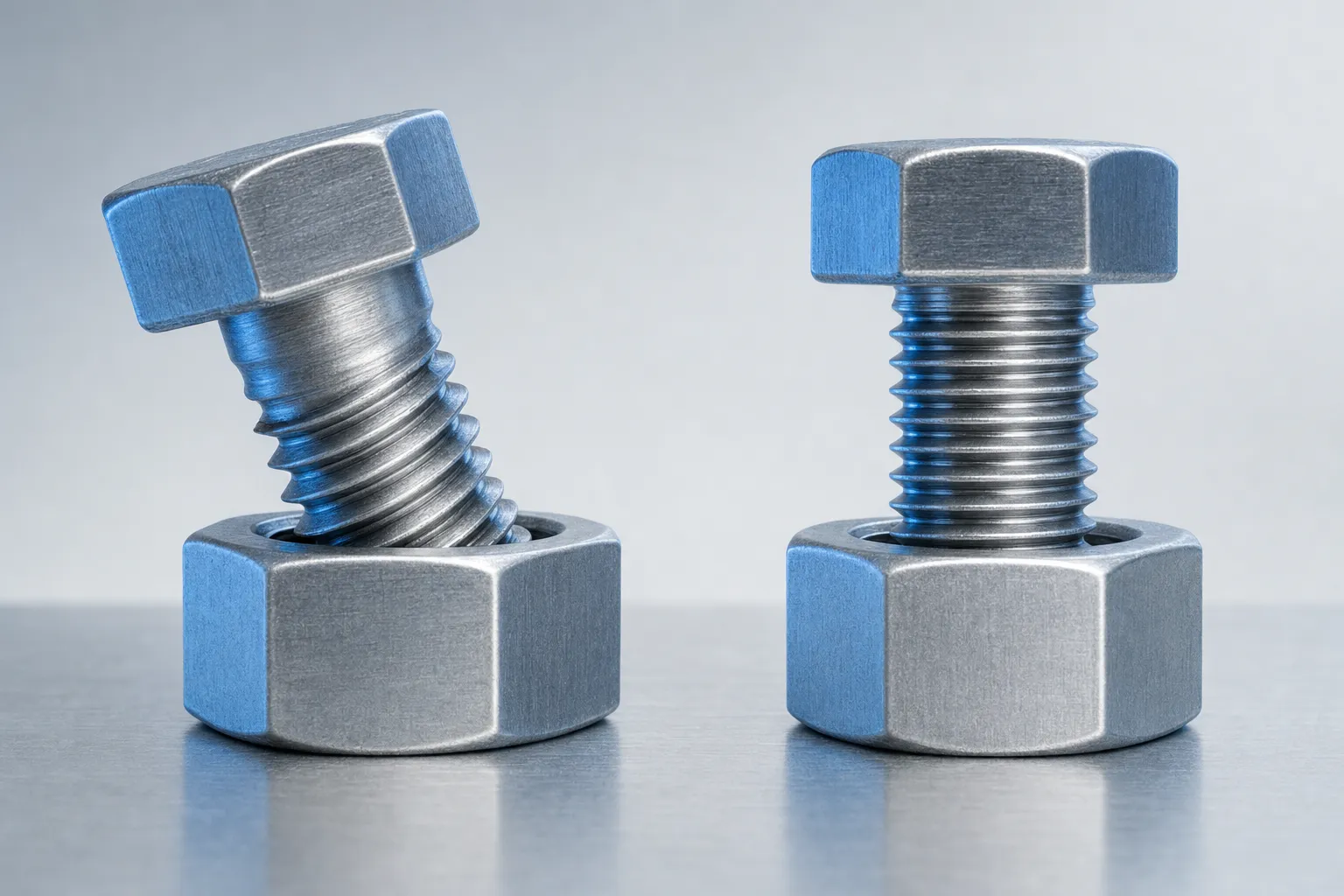
Cross-threading happens when a screw or other externally threaded fastener starts at an angle to the internally threaded part. The thread forms do not engage correctly, and continued rotation can damage one or both sets of threads. The practical response is to stop, check alignment and specifications, and investigate any damage rather than force the fastener onwards.
Risk reduction starts before assembly: confirm that the mating parts have compatible thread specifications, keep the fastener and hole aligned, and use a starting method appropriate to the product and process. These steps reduce risk but cannot guarantee that cross-threading will never occur.
What cross-threading means
A screw thread is a helix on a cylindrical or tapered surface. In a correctly started assembly, the fastener’s external thread follows the path of the female thread. If the axes are misaligned, the thread helices do not engage as intended. The fastener may begin to turn, but its thread can ride over, cut into or otherwise damage the mating thread.
EJOT describes cross-threading as assembly with a screw axis misaligned to the female thread, causing thread damage that can make final assembly impossible. This is a useful description of the mechanism, though a fastener that jams is not automatically cross-threaded. The MAThread FAQ notes that similar symptoms can also come from false threading, paint interference, thread-quality issues, dirt or other obstructions. See the EJOT MAThread and MATpoint flyer and MAThread FAQs.
In practice, people sometimes use “cross-threading” as a broad label for a fastener that binds or jams. For diagnosis, separate the symptom from the cause. A fastener that stops early might be misaligned, but it could also meet contamination, coating, an incorrect thread or a damaged feature. Do not assume that applying more force will identify or resolve the problem.
Cross-threading and other thread problems
The terms below describe different mechanisms. More than one type of damage can occur in the same assembly, so an initial cross-thread can be followed by stripping or galling.
| Condition | What happens | Typical distinction |
|---|---|---|
| Cross-threading | Mating threads start out of alignment and engage incorrectly, damaging the thread path. | The problem begins during starting or early engagement, often with the fastener not square to the hole. |
| Stripping | Thread material or its load-carrying form is damaged or removed, so the threads can no longer provide the intended engagement. | May follow excessive load or damaged engagement; it is not defined by an initial angular misalignment. |
| Galling | Contact and friction cause material adhesion between surfaces, which can lead to seizing. | More associated with adhesive damage and seizure than with a fastener starting on the wrong thread path. |
| Intentional thread forming | A designed fastener displaces material to create a mating thread as it is installed. | This is a planned joining method, not cross-threading, provided the fastener, material and receiving feature are suitable. |
Stripping describes loss or failure of the thread engagement, not the reason the fastener first started incorrectly. Galling is a friction-related adhesive wear process. PENCOM explains that galling can occur when contact wears away protective oxide layers on materials such as stainless steel, titanium and aluminium, allowing solid-phase welding and adhesion. Its guidance identifies factors including friction, heat, material pairing, cleanliness, installation speed and misalignment. These are product and process considerations, not proof that a seized fastener has galled. Refer to PENCOM’s guidance on galling of stainless steel fasteners.
Thread forming is different again: it is intentional when the fastener is designed to form a thread in a specified material and receiving feature. Covestro’s design guide distinguishes thread-forming screws, which displace material, from thread-cutting screws, which remove it. Its recommendations concern particular plastic joining applications; they should not be treated as universal rules for all materials or fasteners. For more on that application, see thread-forming screws for plastic and hole sizing.
Common causes
Misalignment at the start. A tilted screw, stud or receiving component can make the thread crests meet in the wrong position. Side loading, poor access, an unsupported part or an approach that is not square to the hole can contribute. EJOT identifies axis misalignment as the cause of cross-threading in its flyer. The relevant alignment is the relationship between the fastener and the female thread, not simply whether the parts look close together.
Incompatible thread specifications. Parts can look similar while having different thread definitions. Check the specified thread form and size, including pitch and handedness where relevant, against the drawings, part records and supplier documentation. Do not infer compatibility from a fastener turning a short distance into a hole. If parts come from different sources or their identities are uncertain, resolve the specification before assembly. A specification check can prevent a selection error; it does not establish that the actual components are undamaged.
Damaged, dirty or obstructed threads. Burrs, dents, contamination, coating build-up or damaged thread starts can prevent proper engagement. MAThread’s FAQ identifies dirt, obstructions, paint interference and nut-thread quality as possible sources of jamming that may be mistaken for cross-threading. Inspect both mating parts, not only the fastener. Avoid cleaning or reworking a feature in a way that changes its specified form without an approved process.
Thread-entry and component-design issues. A difficult-to-access hole, inadequate guidance or an exposed thread start may make square engagement harder. In moulded parts, the shape around the thread runout can also matter. Covestro recommends avoiding feather edges at thread runouts in moulded-in threads to reduce cross-threading risk. This is manufacturer guidance for the described plastic design context, rather than a general dimensional rule for every threaded component.
How to prevent cross-threading during assembly
Start with the correct parts and a clean, accessible work area. Verify the fastener and mating feature against their approved specifications, and check that the components are free from visible damage or contamination. Where a coating, sealant or other process material is involved, follow the product-specific assembly instructions rather than assuming the thread will accommodate it.
Present the fastener squarely to the female thread before applying installation force. Where the design permits, start engagement gently by hand so that the operator can notice a poor start before a powered tool advances the fastener. This is a general assembly practice, not a substitute for a defined manufacturer procedure. For automated or torque-controlled assembly, use a process designed for the particular joint and follow its approved settings and sequencing; no universal torque or speed can be specified for every fastener and material.
Keep the receiving part supported and aligned while the fastener engages. Do not use the thread to pull misaligned components together. PENCOM specifically lists using threads to draw components together and non-perpendicular installation among factors that can contribute to galling. Regardless of failure mode, correcting component position before engagement reduces avoidable side loading.
If resistance is abnormal at the start, stop and withdraw the fastener without forcing it. Check whether the thread specifications match, whether the parts are square, and whether an obstruction or damaged start is visible. Do not repeatedly attempt engagement with the same suspected damaged fastener, and do not treat increased force, a longer tool or powered driving as a remedy.
Fastener selection and design features
Selection should match the thread specification, receiving material, joint function and installation process. A feature intended to improve starting may reduce sensitivity to presentation, but it does not make assembly errors impossible or remove the need for compatible threads and suitable process control.
As a product-specific example, EJOT describes its patented MAThread® and MATpoint® point design as intended to prevent cross-threading. A US patent for an anti-cross-threading fastener describes lead threads with a curved transition that can guide mating threads towards collinear alignment, and a dog point intended to restrict the presentation angle during insertion. These are descriptions of particular designs, not generic properties of all lead-ins or fasteners. See the US patent description. Product claims should be read in the context of the manufacturer’s documentation and the intended application; they are not a guarantee against incorrect parts, damage or poor installation.
For plastics, selection between thread-forming and thread-cutting screws depends on the material and design. Covestro’s guide discourages thread-forming screws in less compliant materials such as polycarbonate and recommends considering thread-cutting screws there; this is guidance within that design context, not a universal selection rule.
Fastener details also need to be specified clearly enough for supply and assembly. For threaded studs, identifying the thread ends and other relevant dimensions can help prevent part-selection confusion; see the double-end stud specification guide. Where drive choice affects tool access or engagement, the screw head and drive types guide can help frame the design decision.
Inspection and response to suspected damage
If a fastener binds, sits visibly out of square or shows unexpected damage, stop the operation and segregate the affected assembly as required by the quality process. Inspect the external and internal threads under suitable lighting, looking for displaced material, torn or flattened thread forms, debris, coating interference and damage at the entry. Compare the parts with their identification and approved specifications. Visual inspection can reveal a problem, but it may not establish thread condition or fitness for reuse.
Use the inspection and acceptance methods specified for the product and process. If the cause or extent is uncertain, refer the part to the responsible engineering or quality function. Replacement, repair or rework should follow an approved disposition; do not force a fastener through a damaged thread, and do not reuse a fastener suspected of damage simply because it appears to engage again. Where a female thread may also be affected, assess it rather than replacing only the screw by default.
Where CPQ fits
Structured fastener specification and configuration can help organise product parameters and reduce selection errors, such as choosing a part with the wrong specified dimensions. It cannot control physical alignment during installation, inspect components or guarantee prevention of cross-threading. Engineering approval and appropriate production controls remain necessary.
When an assembly shows signs of thread damage, document the parts and process conditions and route the issue through the relevant engineering or quality review before production resumes.
Frequently Asked Questions
What is cross-threading?
Cross-threading occurs when a fastener starts out of alignment with its mating female thread. The threads engage incorrectly and may be damaged as the fastener is turned.
How can I tell cross-threading from a thread that is simply tight?
A tight fit alone does not identify the cause. Stop if resistance is unexpected, then check alignment, part specifications, thread condition and possible contamination rather than applying more force.
Can I reuse a fastener after cross-threading?
Do not reuse a fastener suspected of thread damage unless an approved inspection and disposition process confirms it is suitable. Assess the mating female thread as well.
Does hand-starting prevent cross-threading?
Gentle hand-starting, where the design and process permit it, can help reveal a poor start before powered installation. It reduces risk but does not guarantee prevention or replace the approved assembly procedure.
Is thread forming the same as cross-threading?
No. Thread forming is an intentional method in which a designed fastener creates a mating thread in a specified material. Cross-threading is unintended engagement caused by misalignment.