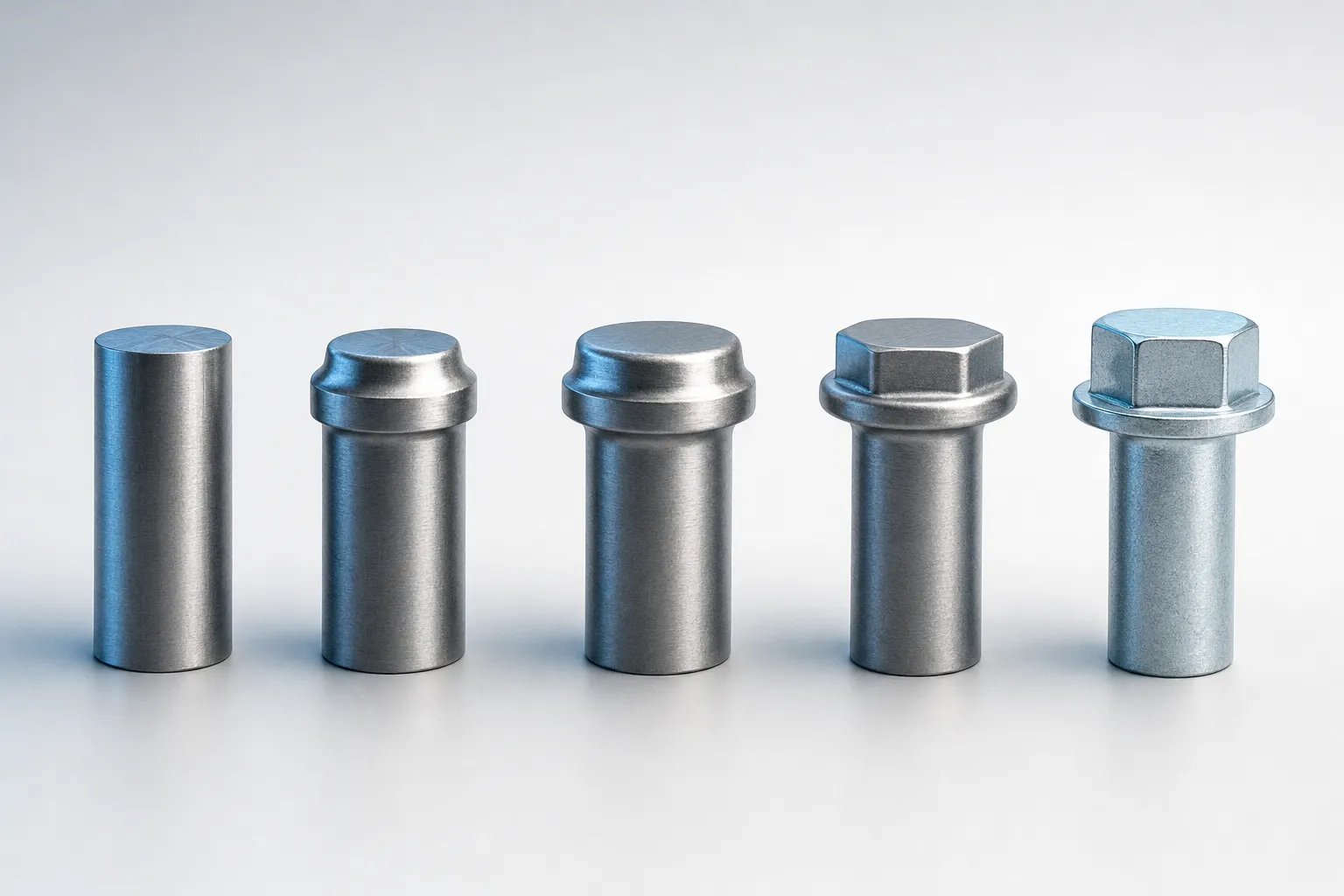
Cold-formed fasteners are made by pushing a metal blank into dies so that material flows into the required shape, rather than removing most of the shape by machining. Cold forming is the broader term; cold heading usually refers to forming fastener blanks, particularly heads and bodies, using a heading machine. A manufacturer needs to assess the part geometry, specified material, tolerances, secondary operations and expected quantities together before confirming a production route.
The cold heading process can combine several forming steps, followed by operations such as thread rolling, trimming or pointing where required. The precise route depends on the part and the manufacturer’s equipment. An enquiry is most useful when it includes a controlled drawing, complete material and finish requirements, and a clear description of the required quantities and delivery pattern.
What cold forming and cold heading mean
In cold forming, a blank is confined by dies and shaped under pressure at ambient temperature. The force causes plastic flow in the material. The process can include upsetting, which moves material to form a head or bulge, and extrusion, which changes a section by pushing material through or into a die feature. Several forming actions may be used on one part.
Cold heading is a fastener-focused application of cold forming. The starting blank is commonly cut from wire, then shaped by a punch and die. The terms are sometimes used loosely in supplier discussions, so an enquiry should describe the required part and process expectations rather than relying on the label alone. The Fastener World and NNI Training overview also distinguishes cold forming from warm forming, hot forming and screw machining as alternative ways of producing a blank.
A high-level manufacturing sequence
A typical route begins by cutting a measured blank from wire or another feedstock. The blank is aligned in a die, struck by a punch and ejected. More complex parts can pass through multiple stations, with each station performing part of the shape. Carpenter Technology’s guide describes multi-station part formers transferring the part between dies.
The volume of material in the blank matters: Carpenter Technology notes that the volume stays constant during heading, making consistent blank cut-off volume important. This is one reason the required dimensions and material condition need to be reviewed as a connected set rather than as separate purchasing fields.
An illustrative hex-bolt route described by Tanner Bolt & Nut starts with cut-off and upsetting, then forms the head features and extrudes part of the body in preparation for thread rolling. The route also includes trimming the hex, pointing and rolling the thread between dies. This is an example, not a universal sequence; different designs and manufacturing equipment can require different operations.
Thread rolling is a displacement operation performed after forming: dies shape the thread by moving material rather than cutting a thread with a tool. The required thread specification and its relationship to the blank geometry therefore need to be reviewed as part of the manufacturing plan.
Geometry, material and production volume
Geometry and forming route
Geometry determines how material must move through the dies and how many forming actions may be needed. Relevant features can include the head profile, shank sections, shoulders, recess or drive, under-head details, point and thread. A manufacturer may need to review whether these features can be formed in sequence, whether trimming or another secondary operation is needed, and how the part will be held and transferred between operations.
A drawing should show the complete part, including views or sections needed to explain features that are not clear in a single projection. Identify critical dimensions and relate them to the function of the part. If a feature is especially important for assembly or fit, state that explicitly rather than assuming it will be evident from the drawing. For guidance on specifying a two-ended threaded component, see the double-end stud specification guide. The guide to screw head and drive types can also help make head and drive requirements unambiguous.
Material
State the requested material grade or specification, and include any required condition or documentation. Material affects whether a proposed forming route is suitable, so the manufacturer needs to know what is mandatory and where an alternative could be considered. Do not assume that a visually similar grade or a different supply condition is interchangeable; ask for review if substitutions are possible.
Material-specific forming guidance is not a universal approval for every part. Carpenter Technology’s guide focuses on cold forming specialty alloys, so its advice should be understood within that scope. The actual material, dimensions, geometry and process still need to be reviewed for the enquiry in question.
Production quantities
Give the expected initial quantity and the likely repeat or annual demand if known. Include whether the requirement is a one-off, a production release or a forecast, and note expected order frequency or batch pattern. Production volume can affect whether dedicated tooling and a particular forming route are practical, but there is no universal volume threshold that determines feasibility. The manufacturer must consider the part, equipment, tooling, setup and demand pattern together.
Secondary operations and finishing
Cold heading may form a near-net shape, but not every feature is necessarily completed in the heading machine. Depending on the design, additional work can include trimming, piercing, sizing, thread rolling or pointing. Carpenter Technology lists these among operations that may accompany heading. Tanner Bolt & Nut’s hex-bolt example illustrates how head trimming and thread rolling can follow the main forming stages.
Specify each required operation and the finished condition of the part. For coatings or other finishes, give the required finish description and any relevant acceptance or documentation requirements. If a process is only preferred rather than mandatory, say so. Manufacturers can then assess whether the specified route and sequence are appropriate, and whether finishing affects dimensions or inspection needs. Do not leave an important post-forming operation implicit in a drawing note that may be overlooked during quotation.
What to include in a manufacturing enquiry
A complete enquiry lets the manufacturer assess the part, process and commercial scope without guessing. The table below is a practical checklist; not every field applies to every fastener, but any requirement that affects fit, function or acceptance should be made explicit.
| Enquiry information | Why the manufacturer needs it |
|---|---|
| Controlled drawing with revision and units | Establishes the part definition and prevents quotation against an obsolete or incomplete drawing. |
| Full geometry, including sections and detail views where needed | Shows the features that must be formed, machined or otherwise produced. |
| Dimensions and tolerances, with critical features identified | Helps assess process requirements and how conformity will be checked. Tolerances should be tied to functional needs, not guessed by the supplier. |
| Material grade or specification and required condition | Enables review of material suitability and supply requirements for the proposed route. |
| Thread details and any applicable thread requirements | Defines what must be produced and inspected; the manufacturer can review its relationship to the blank and forming sequence. |
| Head, recess, drive and point requirements | Clarifies interfaces, assembly needs and features that may require a particular operation. |
| Finish, coating and required documentation | Defines the final supplied condition and any associated inspection or records. |
| Initial quantity, repeat quantity or forecast, and order pattern | Gives context for assessing tooling, production planning and quotation assumptions. |
| Inspection, packaging and traceability requirements | Identifies acceptance and delivery needs that may affect the manufacturing and supply scope. |
| Samples, reference parts or permitted alternatives, if applicable | Helps resolve interpretation questions and makes any flexibility or restriction clear. |
The drawing and enquiry should agree. If the drawing specifies a tolerance but the enquiry asks for a different acceptance condition, resolve the discrepancy before requesting a firm quotation. Where a tolerance is not yet established, identify the functional requirement and ask the manufacturer to review what can be proposed; do not treat an unconfirmed capability as an agreed specification.
For design work that depends on digital geometry, a CAD model can support communication but should not silently replace the controlled drawing or its requirements. See the guide to screw CAD models and parametric generation for considerations when using model files.
Feasibility and quotation: what needs review
A quotation depends on more than the nominal size of a fastener. Manufacturers may need to evaluate whether the material and blank dimensions suit the forming sequence, how the geometry can be divided among stations, and whether secondary operations or special tooling are needed. They also need to understand the required tolerances, finish, inspection scope, quantities and delivery expectations.
Request individual manufacturing review when the geometry is unusual, a feature has tight or function-critical tolerances, the material is uncommon or specified with a particular condition, or the design combines several demanding features. The same applies when drawings are incomplete, the specification conflicts with a sample, or the proposed finish and dimensions may interact. These are prompts for discussion, not evidence that a part is impossible or feasible.
The manufacturer may return questions, propose a process or request design clarification before providing a firm quotation. Distinguish a preliminary estimate from an accepted production specification, and record any agreed deviations or assumptions. A process discussion does not itself establish compliance; production approval and any required verification remain separate responsibilities.
Supporting enquiry-to-quotation with structured requirements
Structured product information can make it easier to capture standard choices and dimensions consistently, generate quotation inputs and route incomplete or unusual requests to an engineer. A CPQ workflow can organise those steps, but it should not be treated as automatic manufacturing-feasibility approval. Fastener-specific rules, calculations and integrations need to be defined for the particular project. Learn more about fastener configuration and quotation.
For an enquiry involving a non-standard material, uncertain geometry or critical tolerance, provide the drawing and requirements for individual review. If you need to discuss structuring a fastener enquiry or quotation process, contact allpccloud.
Frequently Asked Questions
What is the difference between cold forming and cold heading?
Cold forming describes shaping metal by plastic flow under pressure at ambient temperature. Cold heading is a fastener-focused form of cold forming, commonly used to shape a blank in dies.
Does every cold-formed fastener use the same manufacturing sequence?
No. The route depends on the geometry, material, required features and available equipment. A manufacturer may combine several forming stations with secondary operations such as trimming or thread rolling.
What information should I send for a cold-formed fastener quotation?
Provide a controlled drawing with dimensions and tolerances, material and condition, thread and finish requirements, and expected quantities. Include inspection, packaging or documentation needs, and identify any critical features or permitted alternatives.
Can a manufacturer confirm feasibility from a CAD model alone?
A CAD model can help communicate geometry, but it may not define tolerances, material, finish or acceptance requirements. Provide the controlled drawing and full specification, and request individual review for uncertain or demanding features.
Does using CPQ software confirm that a fastener can be manufactured?
No. CPQ can structure requirements and support quotation workflows, but it does not replace manufacturing review, engineering approval, testing or certification. Exceptions should be routed to the appropriate reviewer.